Dehydration
Inadequate fluid intake concentrates minerals in urine, the single biggest modifiable risk for stone formation.

UrologyKidney Stones
Precise evaluation and minimally invasive treatment for kidney and urinary stones — from simple passage guidance to advanced laser lithotripsy — at Dhanya Speciality Hospital.
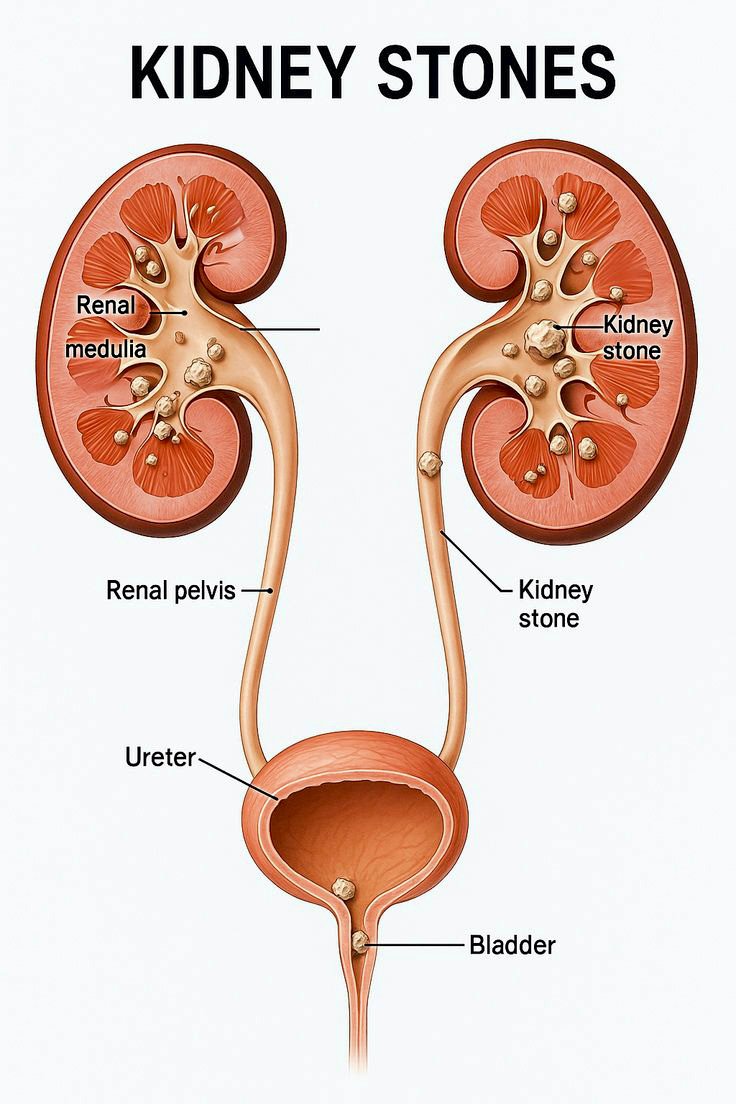
Recognise the signs
Symptoms depend on the stone's size and location. Small stones may cause no symptoms at all and pass silently. Larger stones or those blocking the ureter produce the characteristic pattern below.
Seek immediate care if…
You have fever + flank pain, complete inability to urinate, uncontrollable pain or vomiting, or a single kidney with suspected obstruction. These are urological emergencies requiring same-day evaluation.
Why stones form
Most kidney stones form when urine becomes oversaturated with stone-forming minerals. Understanding your risk factors guides targeted prevention after treatment.
Inadequate fluid intake concentrates minerals in urine, the single biggest modifiable risk for stone formation.
High sodium, animal protein, and oxalate-rich foods raise urinary calcium and oxalate levels — key stone-forming substances.
Conditions like hyperparathyroidism, gout, renal tubular acidosis, and certain medications increase stone risk.
A first-degree relative with kidney stones more than doubles your lifetime risk, regardless of diet.
How we treat
Every stone case is different. Our urologist guides you through each step — from first evaluation to procedure and long-term prevention.
Full history, physical exam and urine analysis to characterise symptoms and rule out urgent complications.
Ultrasound for initial screening; CT-KUB for precise stone size, location and density when clinically indicated.
Stone characteristics, obstruction and infection determine whether conservative management, lithotripsy or surgery is appropriate.
URSL, RIRS, PCNL or flexible laser lithotripsy performed with Thulium Fiber Laser; DJ stenting when required.
Post-procedure review, metabolic workup for recurrent formers, and tailored hydration and dietary counselling.
Advanced capabilities
Dhanya Speciality Hospital performs the full spectrum of stone procedures supported by laser, endoscopic and imaging technology.
Accurate evaluation
Detailed review of pain character, onset, associated symptoms, previous stone episodes, medications, and relevant medical history.
Urinalysis detects blood, crystals and signs of infection. Urine culture is requested when infection is suspected alongside obstruction.
Ultrasound for initial screening; CT-KUB (non-contrast CT) for precise stone size, number, density and location — the gold standard for stone detection.
For recurrent stone formers, blood and 24-hour urine studies identify correctable biochemical causes — reducing future stone risk substantially.
Patient questions
A kidney stone is a hard crystalline deposit that forms within the kidney or urinary tract from minerals in concentrated urine. Stones range from a grain of sand to a pebble and may pass unnoticed or cause intense pain.
The hallmark is severe, colicky flank pain radiating to the groin — often described as one of the most intense pain experiences. It can come in waves and may be accompanied by nausea, vomiting and blood in urine.
Stones under 4–5 mm often pass spontaneously with adequate hydration and pain management. Larger stones, those causing infection or complete obstruction, typically require medical or surgical intervention.
Seek immediate care for fever with stone symptoms (possible infected obstruction), inability to urinate, uncontrollable pain or vomiting, or a single kidney with obstruction — all are urological emergencies.
Dhanya Speciality Hospital performs URSL with DJ stenting, RIRS, PCNL (unilateral and bilateral), URS + Thulium Laser Lithotripsy, and Flexible URS + Thulium Laser Lithotripsy using the UROLASE SP IPG laser.
Drink 2–3 litres of water daily, reduce sodium and animal protein, and follow dietary guidance based on your stone type. A metabolic workup after a second stone helps identify correctable biochemical causes.
Dhanya Speciality Hospital offers same-day urology consultation in Rajapalayam for stone-related emergencies and elective evaluation.