Benign Prostatic Hyperplasia (BPH)
The most common prostate condition in men over 50. The prostate gland gradually enlarges with age, pressing on the urethra and causing lower urinary tract symptoms (LUTS).

UrologyProstate Care
From enlarged prostate and urinary obstruction to prostatitis and screening — specialist-guided prostate evaluation and treatment at Dhanya Speciality Hospital.
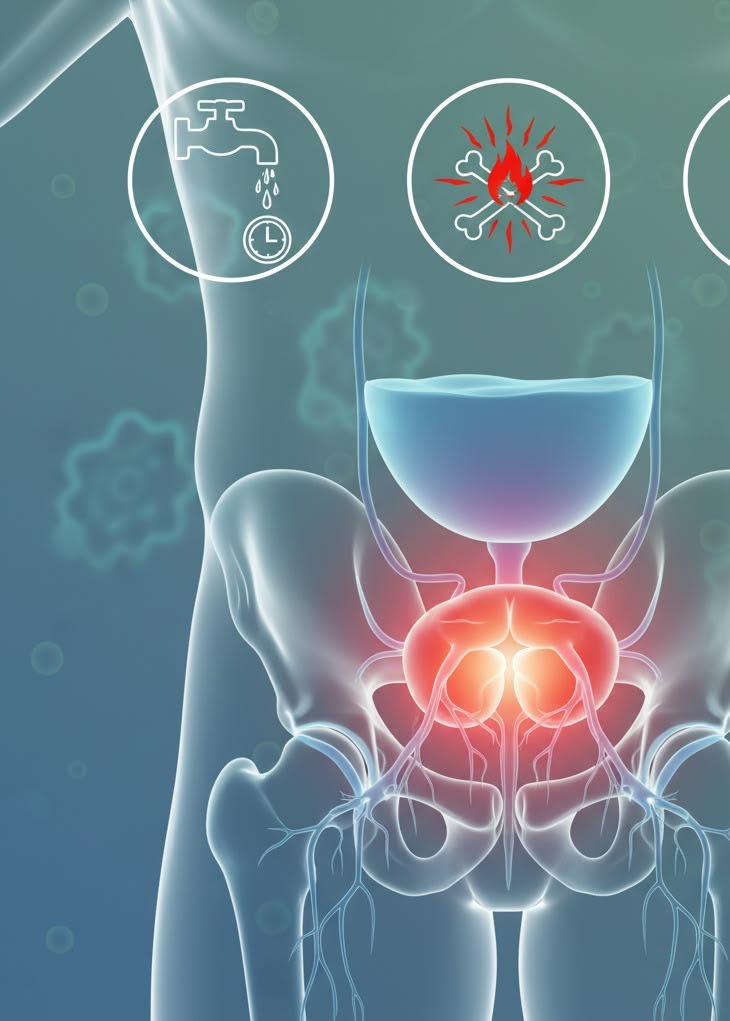
Recognise the signs
Prostate-related symptoms develop gradually and are often normalised as "ageing." Most are treatable — early evaluation identifies the underlying cause.
When to seek urgent evaluation
Sudden inability to urinate, high fever with pelvic pain, blood in urine or rapidly worsening urinary symptoms require same-day or emergency medical assessment — do not delay.
What we treat
Prostate symptoms can arise from several different conditions. Accurate diagnosis is the foundation of appropriate treatment.
The most common prostate condition in men over 50. The prostate gland gradually enlarges with age, pressing on the urethra and causing lower urinary tract symptoms (LUTS).
Inflammation of the prostate, which may be caused by bacterial infection or have a non-infectious origin. Acute bacterial prostatitis can present with fever, pelvic pain and urinary symptoms requiring prompt treatment.
Prostate cancer is the most common cancer in men. Screening discussions — including PSA testing and what a raised PSA means — should be guided by age, family history and individual risk with a qualified clinician.
Acute or chronic inability to fully empty the bladder, often triggered by untreated BPH or post-operative swelling. Requires prompt evaluation and, when acute, catheterisation.
How we assess
A structured, evidence-based evaluation determines the exact nature and severity of your prostate condition before any treatment decision is made.
International Prostate Symptom Score quantifies symptom burden and guides the urgency and type of intervention.
Assesses prostate size, consistency and any suspicious nodules as part of a comprehensive physical examination.
Rules out urinary tract infection, haematuria and other urinary pathology that may mimic or coexist with BPH.
Ultrasound measures prostate volume and post-void residual urine — a key indicator of bladder decompensation.
Treatment pathways
Treatment is matched to symptom severity, prostate size and individual health. The urologist determines the most appropriate approach after clinical evaluation.
For mild symptoms, active surveillance with lifestyle modifications — fluid management, caffeine reduction, timed voiding — is appropriate and avoids treatment side effects.
Alpha-blockers relax prostate and bladder-neck muscle; 5-alpha reductase inhibitors reduce gland size over months. Combination therapy is used for larger glands.
Cystoscopy, urethral dilatation (GUD) and bladder neck incision (BNI) address obstruction with shorter recovery than open surgery.
Transurethral Resection of the Prostate remains the benchmark surgical treatment for BPH. Tissue is removed endoscopically — no incision, short hospital stay.
Why early care matters
Acute urinary retention
Sudden inability to urinate is a urological emergency requiring catheterisation. Often the first presentation of severely untreated BPH.
Recurrent urinary tract infections
Residual urine in the bladder after incomplete voiding creates a reservoir for bacterial growth, leading to repeated infections.
Bladder stones & damage
Chronic incomplete emptying causes bladder trabeculation, diverticula and eventually bladder stones — all reversible if treated before permanent damage.
Kidney damage
Long-standing high-pressure obstruction causes bilateral hydronephrosis and progressive kidney injury — avoidable with timely treatment.
Patient questions
Benign Prostatic Hyperplasia (BPH) is a non-cancerous enlargement of the prostate gland. It is the most common cause of urinary symptoms in men over 50. BPH is not prostate cancer and does not increase cancer risk.
Men at average risk should discuss prostate evaluation with their doctor from age 50. Those with a family history of prostate cancer or of African ancestry should discuss earlier (age 40–45) screening.
Yes. Mild-to-moderate BPH is successfully managed with lifestyle changes, alpha-blockers or 5-alpha reductase inhibitors in most men. Surgery is reserved for severe symptoms, complications or when medications fail.
TURP (Transurethral Resection of the Prostate) is an endoscopic procedure where the surgeon removes obstructing prostate tissue through the urethra — no external incision. It is the most effective surgical treatment for symptomatic BPH.
Untreated BPH can progress to acute urinary retention, urinary tract infections, bladder stones, bladder wall thickening and, in severe cases, kidney damage from back-pressure. Early evaluation prevents these complications.
BPH is benign overgrowth of the inner prostate gland; prostate cancer arises from the outer zone and can metastasise. Their symptoms can overlap but causes, evaluation and management are entirely different. Only appropriate clinical and laboratory evaluation can distinguish them.
Specialist prostate evaluation and treatment at Dhanya Speciality Hospital, serving Rajapalayam and the wider Virudhunagar district.